01
Choose the Right Tool
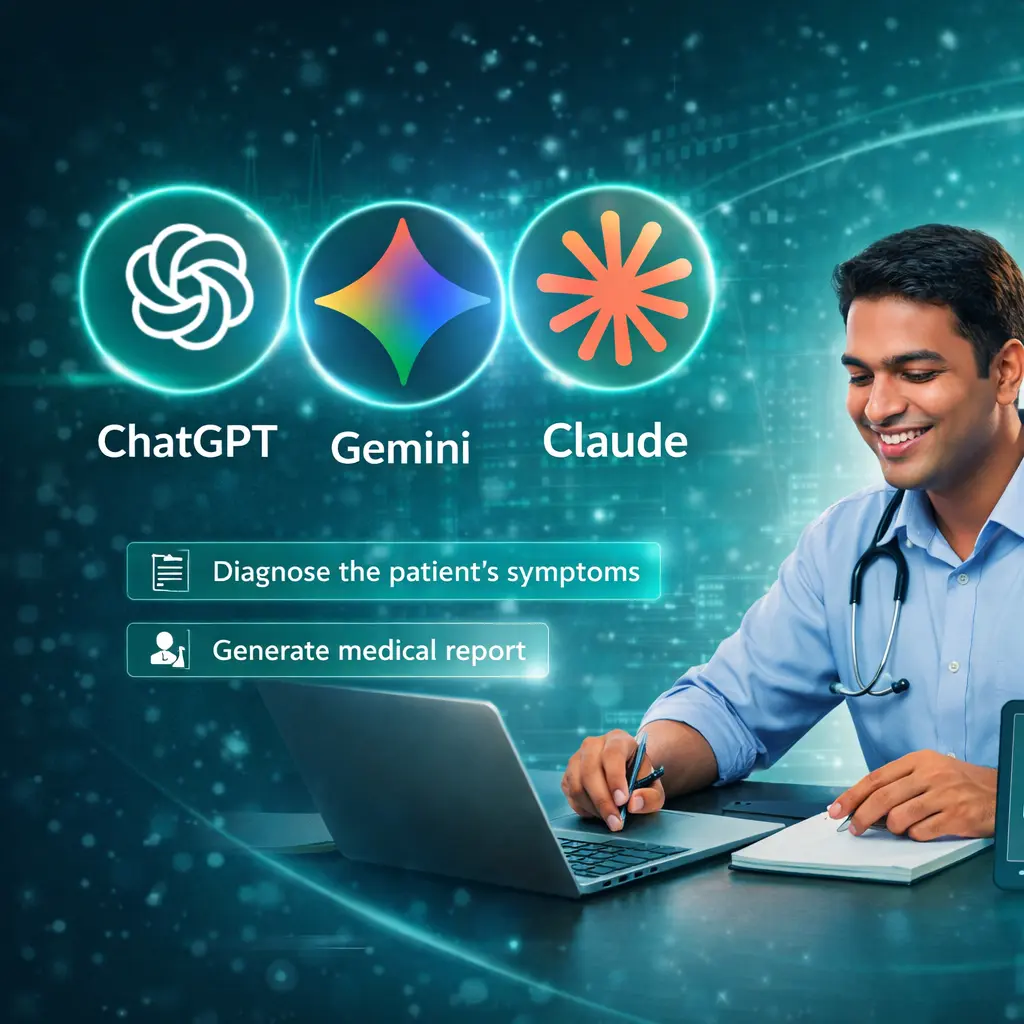
Understand when to use ChatGPT, Claude, Gemini, or a medical AI tool depending on the task.
Learn how to use ChatGPT, Claude, Gemini, and medical AI tools more confidently in real clinical practice.
Built for doctors, consultants, clinic owners, hospital teams, and medical students.
Why This Course Matters
Many doctors try AI once, get weak results, and assume AI is not useful. In reality, the problem is usually poor tool choice, unclear instructions, or unsafe prompting habits. This course helps doctors use AI more accurately, more confidently, and more responsibly in day-to-day clinical work. It gives doctors a practical system for better prompts, safer outputs, and real workflow adoption without technical overwhelm.
Understand when to use ChatGPT, Claude, Gemini, or a medical AI tool depending on the task.
Learn prompting frameworks that turn vague AI responses into structured, usable clinical drafts.
Use doctor-first prompting methods that support judgment, privacy awareness, and responsible use.
Apply AI more effectively in communication, documentation, drafting, and workflow support.
What You Will Learn
Choose the right AI tool for different clinic and medical tasks
Understand the strengths and limitations of ChatGPT, Claude, Gemini, and medical AI tools
Write effective prompts for real clinical workflows and practical use cases
Avoid common prompting mistakes that produce weak, generic, or unsafe outputs
Use safer prompting methods in healthcare settings without overreliance on AI
Build a no-code custom Medical GPT for your clinic, department, or specialty
Use AI more efficiently and cost-effectively in daily professional work
Curriculum
This short course is organized into three core learning blocks so doctors can quickly move from understanding tools to applying them with confidence.
Section 1
Section 2
Section 3
Who This Course Is For
Requirements
The course is designed for medical professionals, not software engineers.
Helpful for relating prompts and tools to your day-to-day practice.
Having ChatGPT, Gemini, Claude, or similar tools available will improve hands-on learning.
Ideal for doctors who want real implementation guidance rather than technical theory.
Delivered by Rigomo
Rigomo is an AI-focused medical education platform dedicated to helping Indian doctors and clinics adopt AI in a practical, safe, and ethical way. It offers structured, real-world training programs designed to simplify clinical documentation, patient communication, and clinic operations using AI—without requiring technical or coding knowledge. Rigomo focuses on doctor-first workflows, ensuring compliance with Indian regulations while empowering healthcare professionals to save time, improve efficiency, and build future-ready practices.

Learn with MS Ansari
MS Ansari is an AI educator, data scientist, and IIT Bombay alumnus who specializes in helping Indian doctors and clinics adopt AI in a practical, ethical, and real-world manner. As the creator of AIDC, he focuses on simplifying complex AI concepts into easy, usable workflows for clinical documentation, patient communication, and clinic operations—while ensuring doctors maintain full control, compliance, and clinical judgment.
Certificate & Takeaways
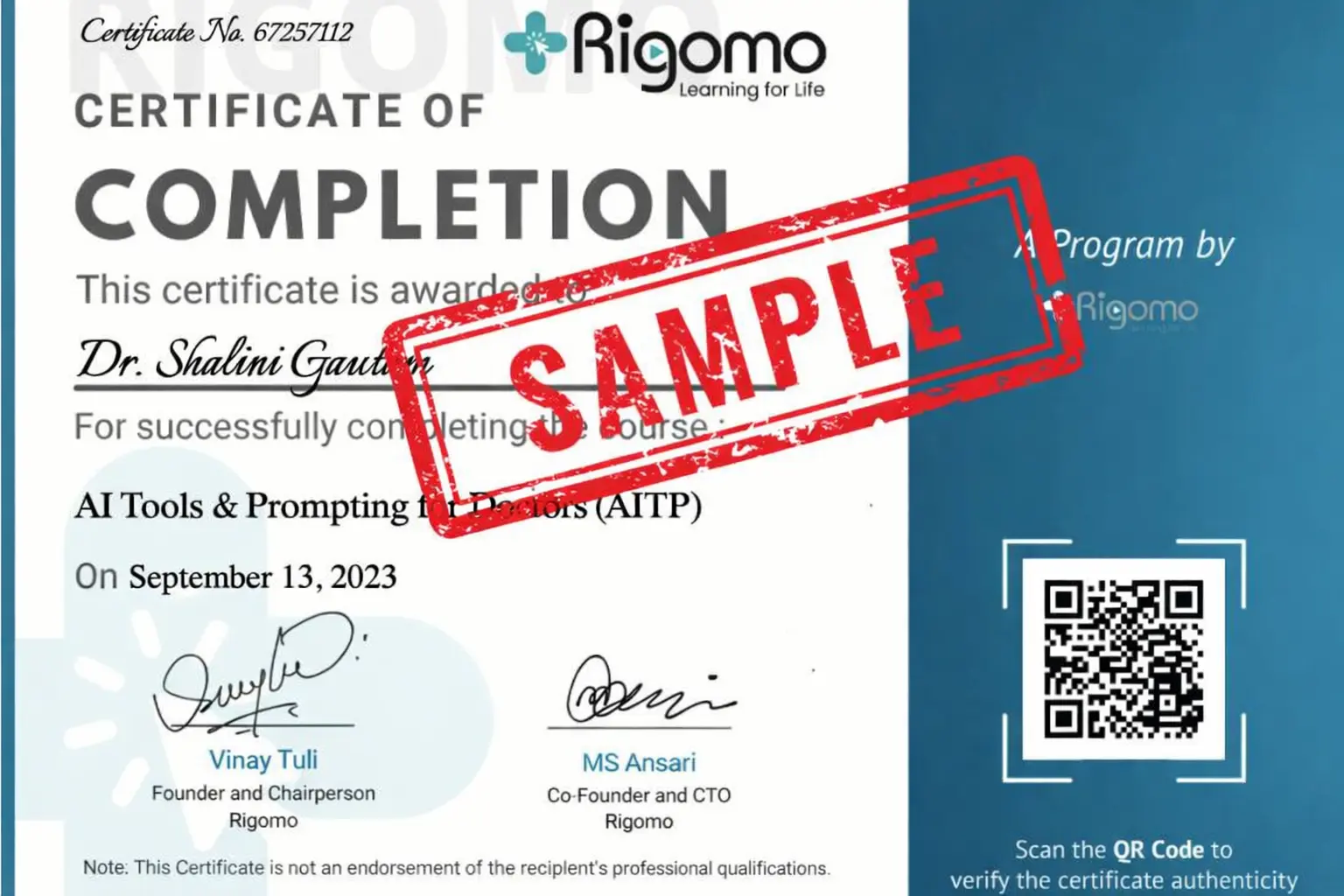
Learn practical doctor-first AI workflows, then finish with a professional certificate of completion from Rigomo.
Know what to use, when to use it, and what to avoid.
Get better outputs for clinic workflows, communication, and documentation.
Show completion of training in AI tools and prompting for doctors.
Frequently Asked Questions
No. This is a practical course designed for doctors and healthcare professionals, with a focus on applied use rather than technical engineering.
No coding knowledge is required. The course is built for non-technical learners who want to use AI effectively in professional workflows.
Yes. It is suitable for beginners, especially doctors who want a structured starting point for AI tool selection and prompting.
Yes. The course is designed to help you use AI tools more effectively for documentation, communication, drafting, and workflow support tasks.
Yes. The examples, positioning, and training approach are built with Indian healthcare professionals and clinical realities in mind.
Yes. The course directly addresses documentation, communication, and practical workflow scenarios where AI can be used more responsibly and effectively.
Start the Course
Learn the systems, prompting methods, and safety habits that help doctors use AI more effectively without losing professional judgment.